Taxus baccata
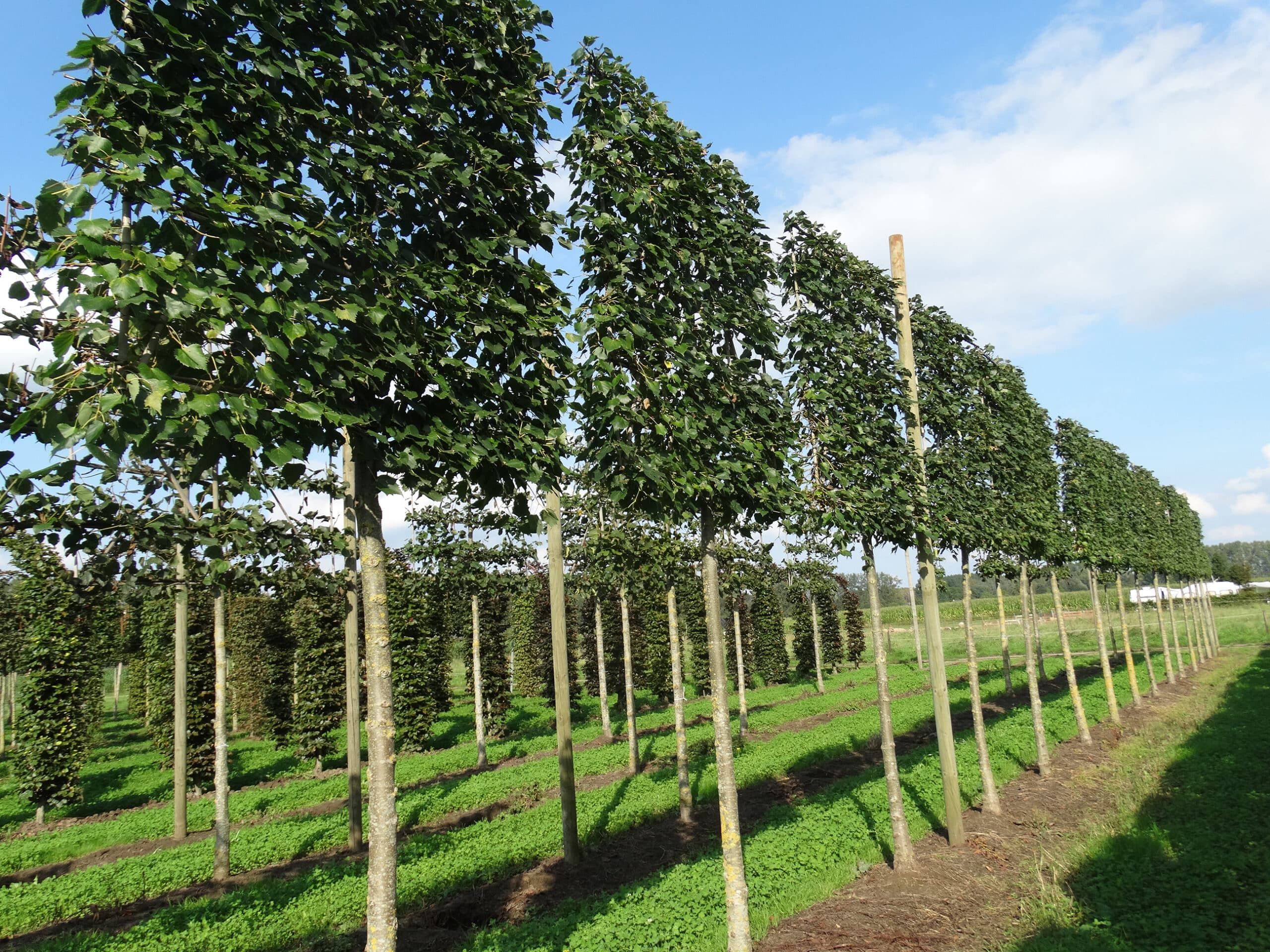
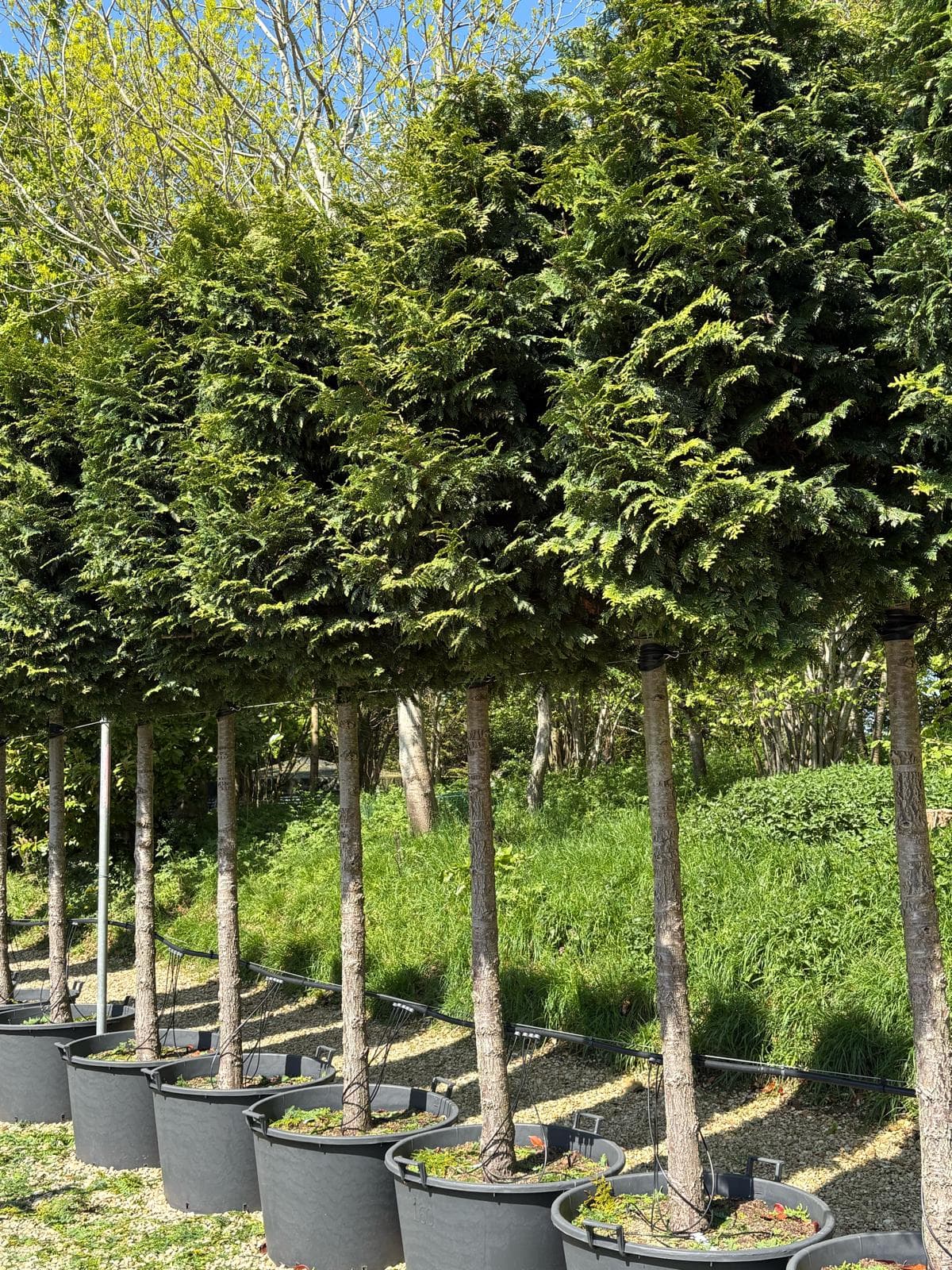
Pleached Yew
Native to the British Isles and considered by many the most elegant evergreen species available, Taxus baccata is a long-lived, tolerant tree with dark green needle-like foliage, the traditional choice for formal hedging and topiary.
or call us directly
01672 861883Product Gallery
The small tightly knit needle like leaves and compact habit create a very tidy formal appearance. Tolerant of all soil types as long as it is free draining. Yew really doesn’t like wet ground – at all!
Evergreen
High and low pleached options
Also available as Hedging, Topiary and Cloud Trees. Please get in touch for more options.
Stem girth from 12-14cm up to 35-40cm, occasionally bigger available but they need booking in advance
Various stem heights and frame sizes available
Trained on frame in pleached form for 1-10 years in some cases even longer
Available in pots and containers, cocoa rootball or rootball
Pleached Yew trees are available for nationwide delivery service by articulated lorry, smaller vehicle by prior arrangement
Browse our current pleached tree stock, selected for structure, form, and maturity
View Stock & PricesYew, Common Yew, European Yew, English Yew – Taxus baccata (Taxaceae)
Taxus baccata is considered by many to be the most stylish and elegant small medium sized evergreen conifer in Britain. A native species it can also be found in Western and Southern Europe, Northwest Africa, Northern Iran and Southwest Asia. Widely accepted as the oldest living plants in Europe, a Yew specimen in Scotland still alive today, is estimated to be 2000-3000 years old. Ten yew trees in Britain are believed to predate the 10th century. A wooden spear head, one of the world’s oldest surviving wooden artefacts was discovered at Clacton on sea in Essex in 1911 and it is estimated to be roughly 450000 years old.
With a dense crown, dark green foliage, slow growing habit and ability to heal from even the most severe pruning, it is widely used as formal hedging, topiary and latterly pleached trees. The foliage is made up of needles, dark green in colour, 1.5-3cm in length. In summer and late autumn small bright red fruit develop, attracting birds such as blackbird, thrush, and fieldfare who feed on them into the winter. In a woodland setting Yew provides important sanctuary for some of Britain’s smallest birds. Tolerant of a wide range of soil types provided they are free draining, the plant will flourish once it takes hold. If drainage is an issue, or you have wet ground, or you suspect flooding (even for short periods), don’t be tempted to plant Yew. In all likelihood the plant will fail. The first sign of a problem is the leaves turning yellow, but by the time you notice this happening it is usually too late to save. Our advice, to install land drains to remedy the problem. Be very cautious when planting in clay-based soils as they are notoriously bad at preventing water from draining away and rotting the roots as a consequence. Be careful not to compact the bottom of a planting pit in areas of clay. On the plus side Common Yew can be found all over London which is surprising considering much of the city sits on rich seams of clay. Good landscapers will always broach the subject and provide a solution for drainage and a course of action.
Yew is very easy to train and shape. The wood is hard, springy and extremely strong and these qualities, combined with the ability to regenerate growth from even the most severe wounds, produce a plant perfect for sculpture. It should be noted the plant is toxic and no part should be ingested. For those with Equestrian centres, liveries and stables, Yew should not be planted on or near paddock fencing where horses and ponies can feed on them. The same advice is given to farmers with livestock. Planting away from these immediate areas where grazing animals can’t feed on the plants is common. Yew enjoys being planted in full sun and partial shade but not full shade as it develops a loose habit with reduced foliage cover in these conditions. Yew can be seen growing happily at stately homes, private estates, parkland, large and small gardens, in tree containers, patio gardens, company headquarters, commercial sites and roof top gardens.
Available as High pleached trees, screens, specimen solitaire pieces and ornamental trees, mature hedge plants and instant hedge elements. Available as exquisite pieces of Yew topiary in all sorts of shapes and sizes up to 6m tall and 250cm wide including balls, domes, low domes, spheres, cubes, blocks, cylinders, columns, beehives, pyramids, multi stems to mention just a few.
Planting advice for pleached trees, Freshly pleached trees, espalier trees and Freshly espaliered trees.
An important consideration when planting Pleached Yew or espalier trees in a straight line is the slope of the ground. Pleached or espalier trees look their best when they are planted on flat or gently sloping ground. Doing so will line up the frames and stems and creating effect of one continuous line when viewed at all angles. Even on a gradual slope this effect can be achieved. However, with a slope of more than 10-12 degrees, it may be necessary to step the trees/frames when planting (the frames on freshly pleached trees can be manipulated to account for a sharper slope of perhaps 15 degree if necessary).
To create a good visual effect, it is important to line up the stems and frames (unless you are planting them in a circle or semi-circle). To start off the planting holes should measure roughly double the width of the rootball or pot….
Read our full planting guide here