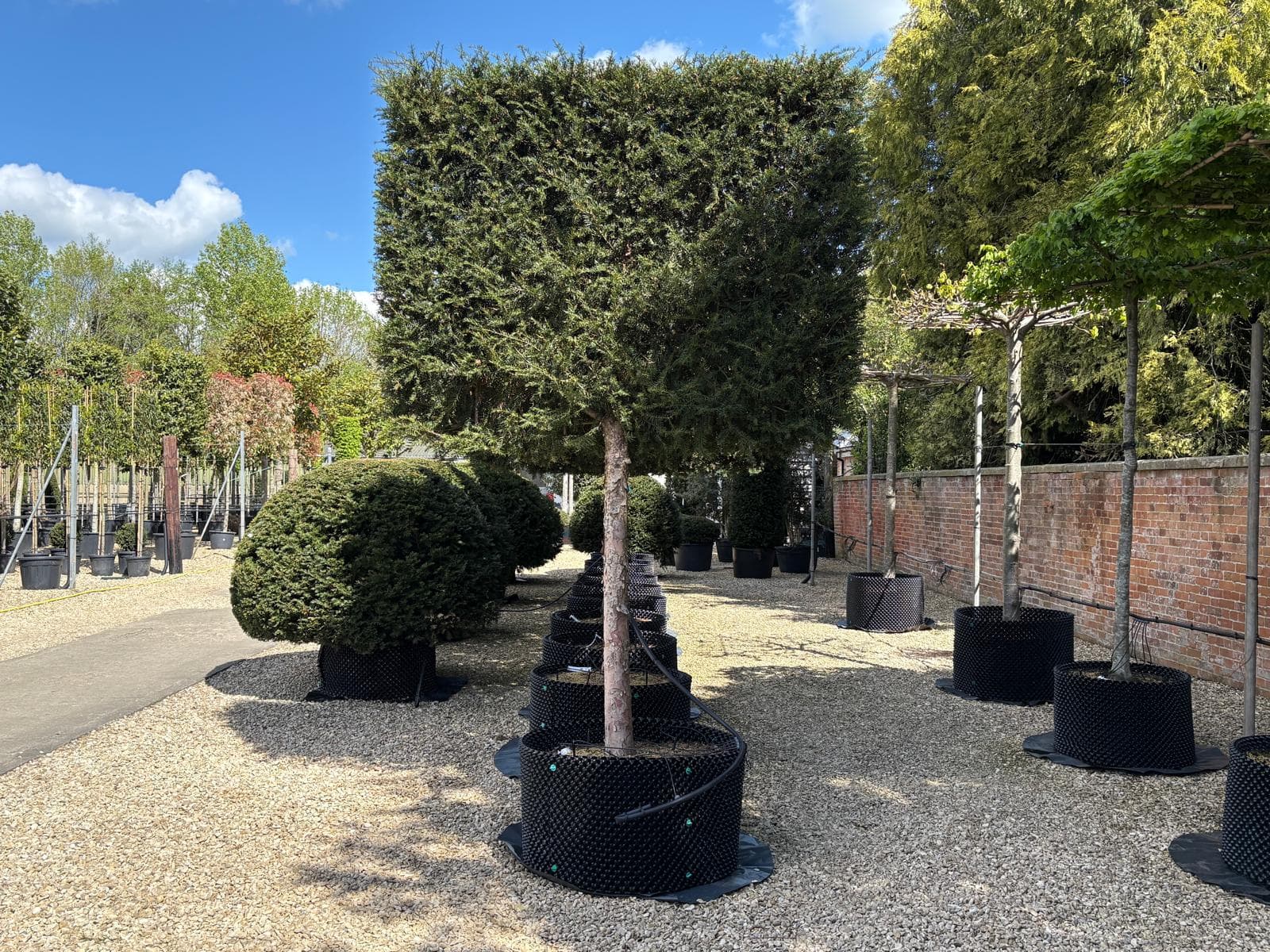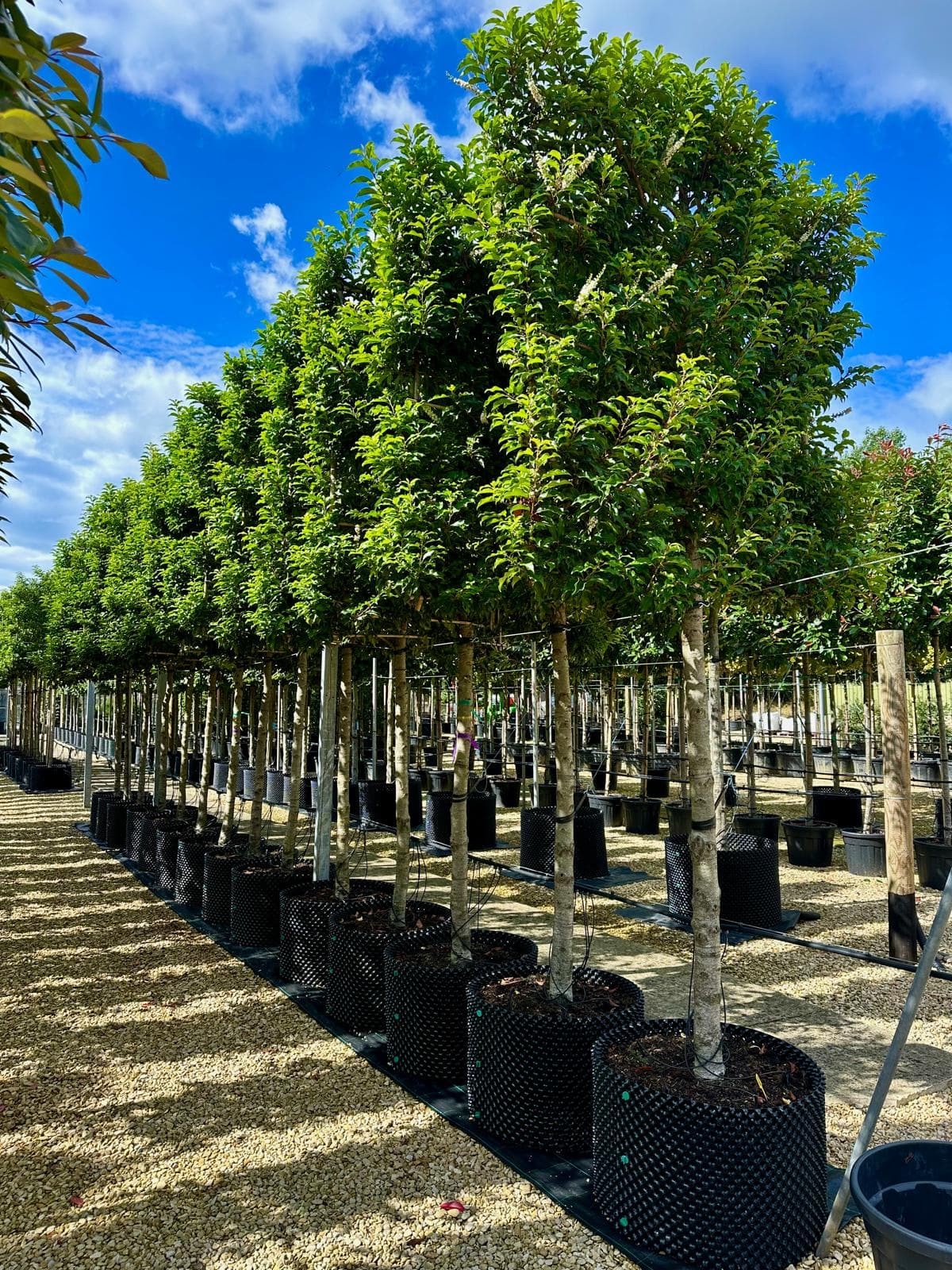
Ilex 'Nellie Stevens'
Pleached Holly
A naturally compact evergreen with glossy dark green spiny leaves, Ilex aquifolium ‘Nellie Stevens’ produces abundant red berries that linger into winter, an upmarket choice for formal screening and an excellent security hedge.
or call us directly
01672 861883Product Gallery
A hybrid cultivar, Nellie Stevens Pleached Holly has an upmarket feel and it responds well to being planted in shadier locations.
Evergreen
High pleached options
Also available as specimen shrubs, specimen trees, clear stem trees,
Stem girth from 12-14cm up to 18-20cm, occasionally bigger available but they need booking in advance
Various stem heights and frame sizes available
Trained on frame in pleached form for 1-5 years in some cases even longer
Pleached Ilex aquifolium ‘Nellie Stevens’ available in pots and containers
Nationwide delivery service by articulated lorry, smaller vehicle by prior arrangement
Browse our current pleached tree stock, selected for structure, form, and maturity
View Stock & PricesPleached Holly, Nellie Stevens Holly, – Ilex aquifolium ‘Nellie Stevens’
With its origins in the USA – G.A. van Lennep, St. Michael, MD, USA, 1954 – The Ilex aquifolium ‘Nellie Stevens’ is an exceptionally nice hybrid of the popular British Common Holly – Ilex aquifolium (One of Britain’s only Native Evergreens) and the Horned Holly Ilex cornuta. With glossy dark green leaves and dark grey-green bark and branches it makes a particularly good standard tree and it fits seamlessly into native landscapes and gardens, producing a quality feel which is hard to beat. Achieving heights of 6-8 meters, its crown has a pyramidal shape and its tight regular habit make it a popular choice for formal training into pleached trees.
Oval elongated leaves measure 5-8cm long, 3-5cm wide, with 2-3 teeth on either side which ensures the observer is in no doubt it is a Holly. In spring new foliage is produced in abundance, having a soft pliable feel to touch. After a few weeks in warmer conditions it soon hardens up to take on the familiar stiff holly feel. From April to May tiny white clusters of flowers turn out with red fleshy berries.
This particular cultivar produces a mass of berries in normal conditions which make it so popular visually, while providing an important source of food for birds – it’s common to see the Black Bird darting in and out of the canopy in the winter months for this very reason. The tree has some toxic elements so avoid eating the berries.
The tree is considered winter hardy and frost resistant (down to -23C) so ideal for the British climate. Of hybrid origin, it is quite happy on windswept sites so a popular choice in these exposed locations. The trees do well in all soil conditions including chalk, clay, loamy, sandy and dry but it does not tolerate wet soils – best to install land drains or similar to drain away water if you have a wet site before planting. It does not like to have its far-reaching roots covered by paving or hard landscaping. As a small to medium sized woodland plant it is quite used to growing happily below the canopies of much larger trees. Being extremely tolerant of shady sites makes this a firm favourite in these conditions. While slow growing, if you are looking for a quality upmarket feel for your project there are very few evergreen alternatives capable of producing the same upmarket feel.
Few trees have the ability to work so well in both contemporary and traditional designs. The Nellie Stevens is one of them. Available as High pleached screens, solitaire pieces and specimen ornamental trees and suitable for small, medium and large gardens. pleached holly is a popular plant available in pots/containers and in some cases rootball in season.
Planting advice for pleached trees and espaliered trees.
An important consideration when planting pleached or espalier trees in a straight line is the slope of the ground. Pleached or espalier trees look their best when they are planted on flat or gently sloping ground. Doing so will line up the frames and stems and creating effect of one continuous line when viewed at all angles. Even on a gradual slope this effect can be achieved. However, with a slope of more than 10-12 degrees, it may be necessary to step the trees/frames when planting (the frames on freshly pleached trees can be manipulated to account for a sharper slope of perhaps 15 degree if necessary).
To create a good visual effect, it is important to line up the stems and frames (unless you are planting them in a circle or semi-circle). To start off the planting holes should measure roughly double the width of the rootball or pot….
Read our full planting guide here