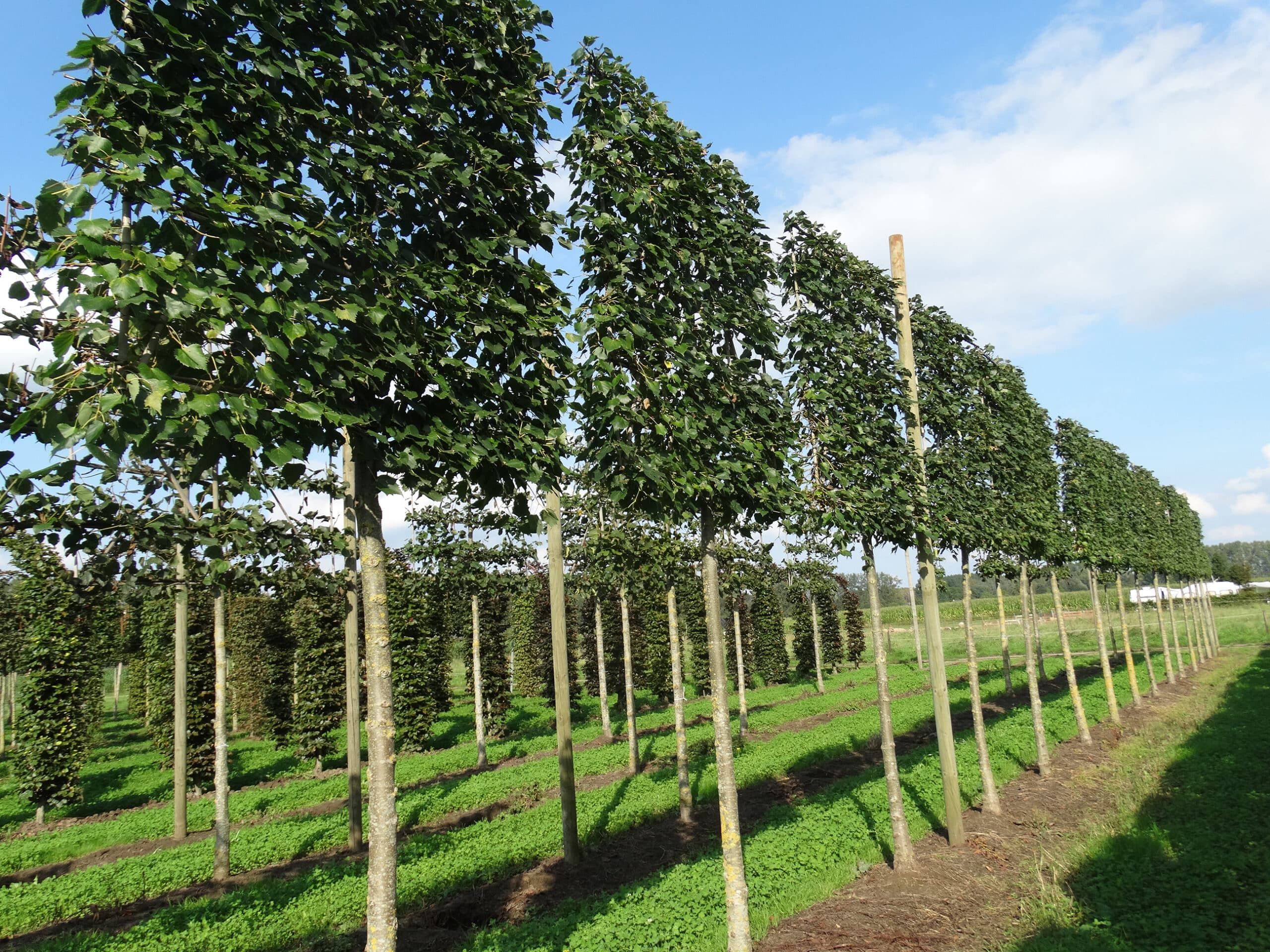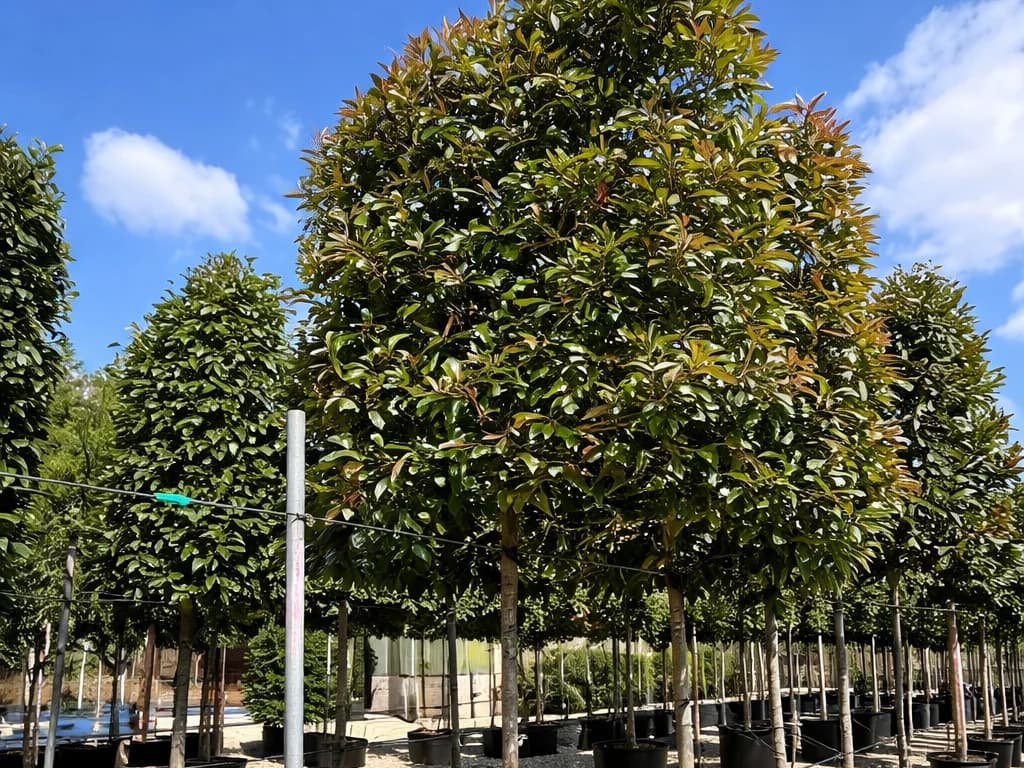
Prunus lusitanica 'Angustifolia'
Pleached Portuguese Laurel
A close-knit, tidy evergreen with small narrow glossy dark green leaves on red stems, Prunus lusitanica ‘Angustifolia’ is a natural candidate for formal training, with fragrant white summer flowers, ideal for screening and front-of-house planting.
or call us directly
01672 861883Product Gallery
There are not many evergreen varieties that display such a tidy habit throughout the season so an ideal candidate if in search of something with a bit of class.
Evergreen
High and low pleached options
Also available as Hedging, plus Standard Trees and Topiary. Please get in touch for more options.
Stem girth from 10-12cm to 18-20cm, occasionally bigger available but they need booking in advance
Various stem heights and frame sizes available
Trained on frame in pleached form for 1-3+ years
Pleached Portuguese Laurel is available in pots and containers
Nationwide delivery service by articulated lorry, smaller vehicle by prior arrangement
Browse our current pleached tree stock, selected for structure, form, and maturity
View Stock & PricesPortuguese Laurel – Prunus lusitanica ‘Angustifolia’ (Rosaceae)
A beautiful small evergreen tree or shrub, the Portuguese Laurel ‘Angustifolia’ can grow to a height of 5-10m on average in its natural environment although taller specimens of 15m have been recorded.
A native to South Western France, Spain, Portugal, Morocco, and the Azores, Canary Islands and Madeira it can be found in gardens and landscapes across Britain and Europe.
With oval dark green leaves on fresh purple to purple green twigs, it’s no wonder this species has become popular in recent years. The leaves are smaller and noticeably narrower than the Prunus lusitanica – the only way to tell the two apart. Small sweet smelling creamy-white fragrant flowers show in June, measure 15 to 25cm long, producing a sweet aroma around the garden attracting birds, butterflies and bees. The flowers are followed shortly afterwards by small, green to red berries which turn dark red to black purple by the autumn. The bark on older branches and stems is smooth and black grey to brown in colour. It is a vigorous grower, not quite as fast as the Common Laurel but it develops a round, dark and dense crown relatively quickly.
This is another species which is doing relatively well in Britain where average temperatures have increased slightly over the last decade. Not suitable for climates where cold drying winds are experienced frequently or at sites where the temperatures fall below -10C. The firm pliable leaf makes this species wind and salt resistant so ideal if you are looking for an evergreen for exposed windy sites or those close to the coast.
It does surprisingly well in all soil types as long as it is fertile and moist – in its natural environment it is most commonly found along mountain streams – a fertile, damp environment. Used extensively in gardens and landscapes across the United Kingdom it tolerates being covered partially by paving. Suited to coastal sites large and small gardens, contemporary and traditional landscapes, roof gardens, parks and industrial sites such as corporate headquarters.
The small leaves and their close-knit habit combined produce a plant that appears formal and opulent even when left completely unmanaged. No doubt it was this formality which first caught the eye of nurserymen looking for suitable species to train accordingly. Today Prunus lusitanica is used extensively in its natural form as hedge plants, large mature hedge plants, specimen shrubs and individual solitaire pieces. In a trained format it is available as pretrained individual hedge plant and instant hedge elements, clear stem trees, topiary including ball on stem, domes on stem, domes, beehives and cubes, High pleached trees and low pleached trees.
Available as rootball plants in the winter months, potted and containerised stock available while stocks last and cocoa rootball can be arranged for delivery throughout summer period by prior arrangement.
Planting advice for pleached trees, Freshly pleached trees, espalier trees and Freshly espaliered trees.
An important consideration when planting pleached or espalier trees in a straight line is the slope of the ground. Pleached or espalier trees look their best when they are planted on flat or gently sloping ground. Doing so will line up the frames and stems and creating effect of one continuous line when viewed at all angles. Even on a gradual slope this effect can be achieved. However, with a slope of more than 10-12 degrees, it may be necessary to step the trees/frames when planting (the frames on freshly pleached trees can be manipulated to account for a sharper slope of perhaps 15 degree if necessary).
To create a good visual effect, it is important to line up the stems and frames (unless you are planting them in a circle or semi-circle). To start off the planting holes should measure roughly double the width of the rootball or pot….
Read our full planting guide here