Fagus sylvatica
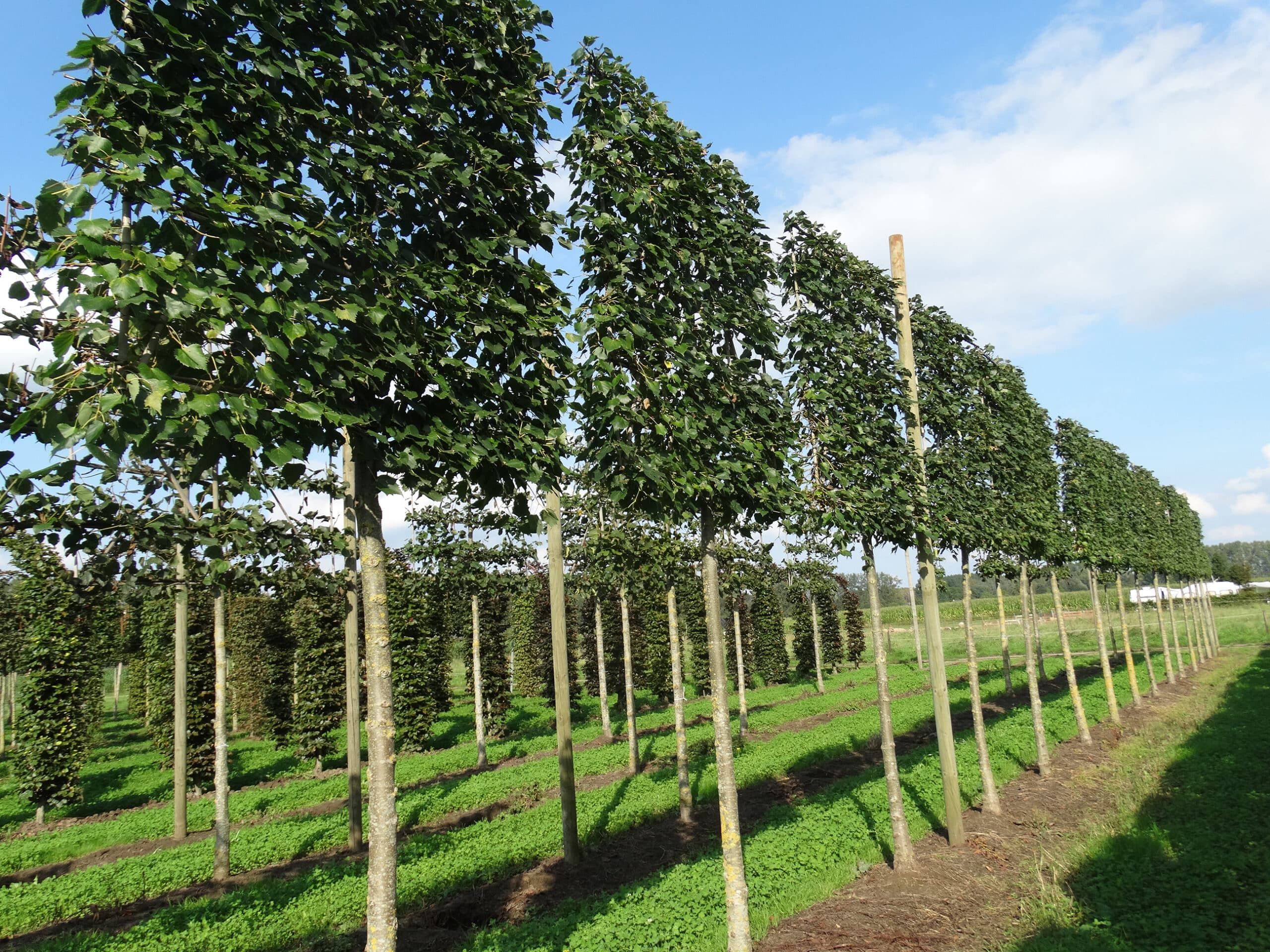
Pleached Beech
One of the most majestic native trees of the British Isles, Fagus sylvatica positively enjoys being managed in a formal, compact fashion, with smooth grey bark and bright green spring foliage that turns golden copper in autumn and is retained through winter, making it a classic hedging and screening tree.
Available Forms
or call us directly
01672 861883Product Gallery
With a splendid green crown turning orange to golden yellow in the autumn, the leaves remain attached in the winter holding on and lingering well into spring.
Deciduous
High and low pleached options
Also available as Hedging, plus Box Head and Standard Trees. Please get in touch for more options.
Pleached Beech clear stem girth from 12-14cm up to 35-40cm, occasionally bigger available but they need booking in advance
Various clear stem height and frame sizes available
Trained on frame in pleached form for 1-10 years in some cases even longer
Available as freshly pleached trees while stocks last
Pleached Beech is available in pots and containers, cocoa rootball or rootball
Nationwide delivery service by articulated lorry, smaller vehicle by prior arrangement
Browse our current pleached tree stock, selected for structure, form, and maturity
View Stock & PricesCommon Beech, European Beech, Green Beech – Fagus sylvatica (Fagaceae)
After the Common Hornbeam, the Common Beech or Fagus sylvatica is one of the most popular deciduous tree species used for the training of pleached trees. It is bigger than the Hornbeam in every respect. It has a less intricate habit, which naturally lends itself to large, less complicated designs such as Pleached Beech trees and majestic pieces of large topiary, some measuring in excess of 5m. In their natural environment the Common Beech are considered a very large tree. They are capable of living for 300 years, attaining a height in excess of 50m and a trunk diameter of up to 3m. Typical lifespans are however 150-200 years old with a height of 30m and trunk diameter of 1.5m
To appreciate their full form as specimen trees they need a lot of space to develop which is why the most impressive specimens are commonly found in large gardens, parkland settings and wide open spaces where they have been allowed to develop untouched and unhindered for generations. In a woodland setting Fagus sylvatica develop tall clean stems with branches only starting high up on the clear stem. In more open settings the trees develop much lower canopies with deer and cattle quite capable of reaching the lower branches.
A Native to the United Kingdom?
Although widely regarded as native to Southern England there is evidence to suggest that Fagus sylvatica did not arrive in England until roughly 4000BC. It is widely spread throughout Europe as far north as Norway and Sweden to Northern Sicily, Western France and Northern Portugal, Central Spain to Northwest Turkey where it meets with the Oriental Beech or Fagus orientalis.
Common Beech have round, dark, dense canopies, with oval to ovate dark green leaves almost waxy in appearance, which arrive relatively late in April or early May. Small catkins develop in May with nuts developing as the season progresses. Historically the nuts were consumed by humans but are considered slightly toxic so best avoided.
Growing Conditions
Pleached Beech trees are winter hardy and frost resistant. It prefers rainfall to be distributed throughout the year so ideal for the British climate. While tolerant of most soil types, clay can be a problem as it prefers well drained, humus rich soil. It doesn’t like flooding or wet soil for extended periods (If you have wet ground and are looking for a close substitute for Beech then Hornbeam may be an option as it tolerates wet conditions far better, another potential solution is to go to the expense of making sure standing water drains away by installing land drains for example). The root system of Beech is shallow and even superficial with large roots developing in all directions and as a consequence it doesn’t tolerate any form of hard landscaping or paving – the reason why you only tend to see large specimens in open landscapes. They have a moderate to good resistance to wind and are suitable for planting in most locations except the most exposed sites.
A Dense Canopy
Walking through a developed Beech forest with summer foliage, you quickly appreciate how little light filters down to the forest floor, it’s a very dark place. As a consequence, Beech tolerate shade to some extent so if you have a shady site this could be the tree for you. While the Beech is considered a large tree, it should not necessarily be discounted for this reason if space is limited. Beech respond well to having their crowns managed so will in fact fit relatively tight spaces if necessary. The trees are typically used in applications ranging from solitaires pieces, avenues, large gardens commercial sites and even windbreaks.
Types of Beech tree supplied by Hedgeworx
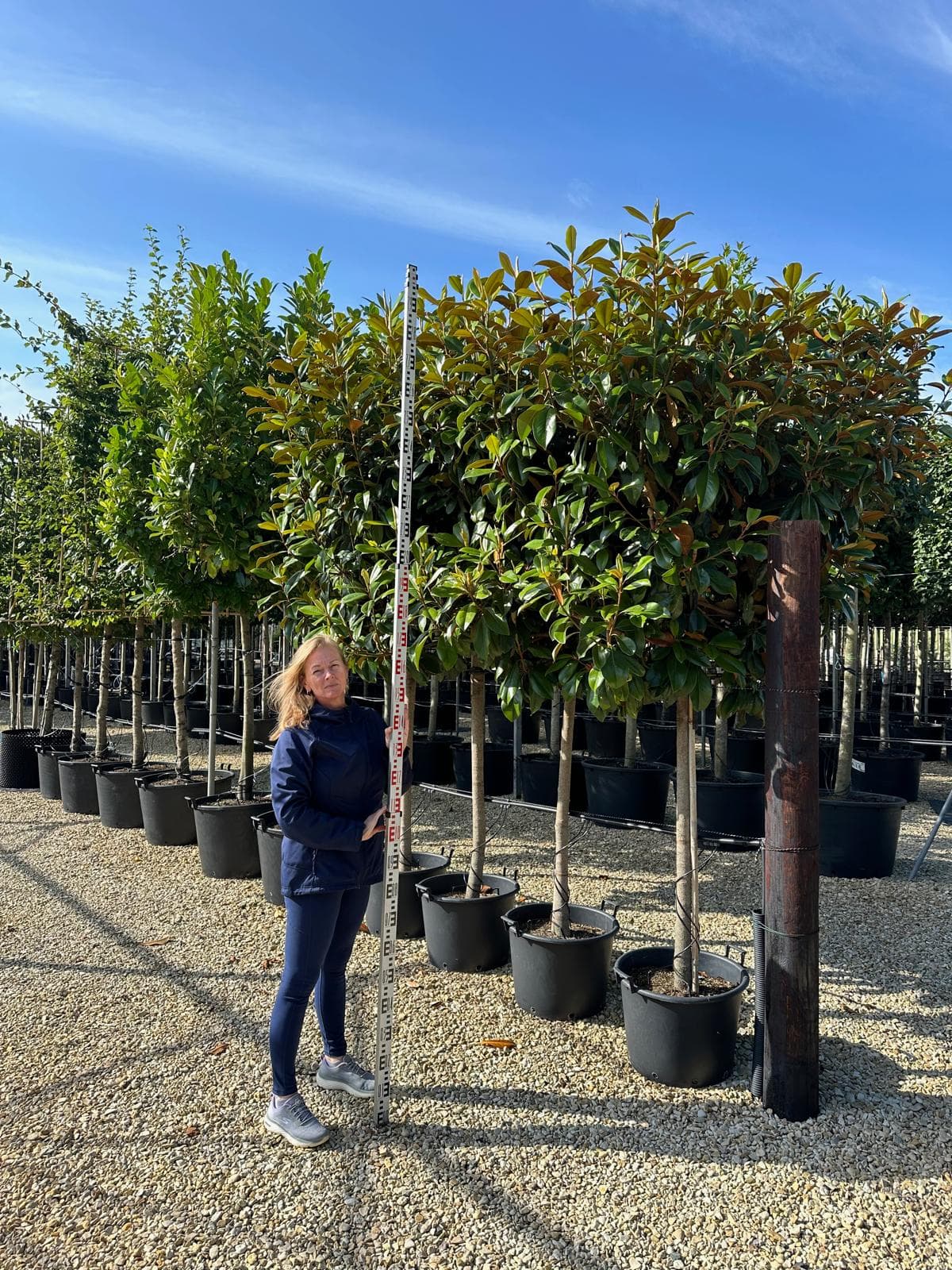
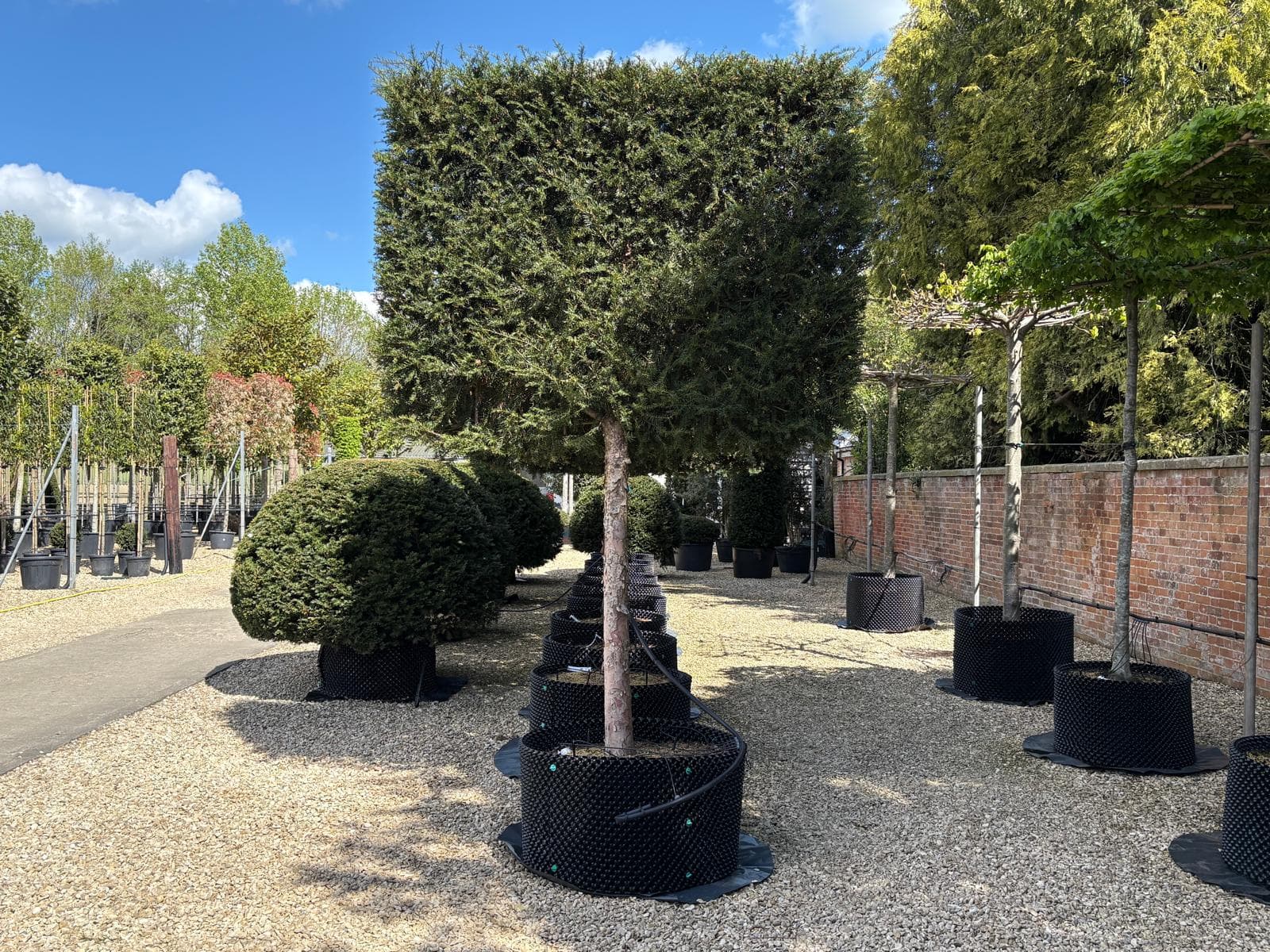
Beech or Fagus sylvatica are popular as hedge plants, specimen trees, clean stem and feathered trees, multi-stem trees, topiary shapes including columns/cylinders/beehives/domes/ball on stem/cube on stem/layer cake/cubes and other topiary shapes. Arches and archway, High and low Pleached Beech trees, block on stem or box head trees. Available as root-ball plants in the winter months, potted stock available while stocks last and cocoa root-ball can be arranged for delivery throughout summer period by prior arrangement.
Planting advice for pleached trees, Freshly pleached trees, espalier and Freshly espaliered trees.
An important consideration when planting pleached trees or espalier in a straight line is the slope of the ground. Pleached or espalier trees look their best when they are planted on flat or gently sloping ground. Doing so will line up the frames and stems and creating effect of one continuous line when viewed at all angles. Even on a gradual slope this effect can be achieved. However, with a slope of more than 10-12 degrees, it may be necessary to step the trees/frames when planting (the frames on freshly pleached trees can be manipulated to account for a sharper slope of perhaps 15 degree if necessary).
To create a good visual effect, it is important to line up the stems and frames (unless you are planting them in a circle or semi-circle). To start off the planting holes should measure roughly double the width of the root-ball or pot….
Read our full planting guide here